AI Agents + ML Models. One Intelligence Layer.
Twelve specialized agents and six purpose-built ML systems that turn raw operational data into prioritized daily work plans. Not generic AI bolted on. An orchestrated pipeline built for the field.
The Agent Pipeline
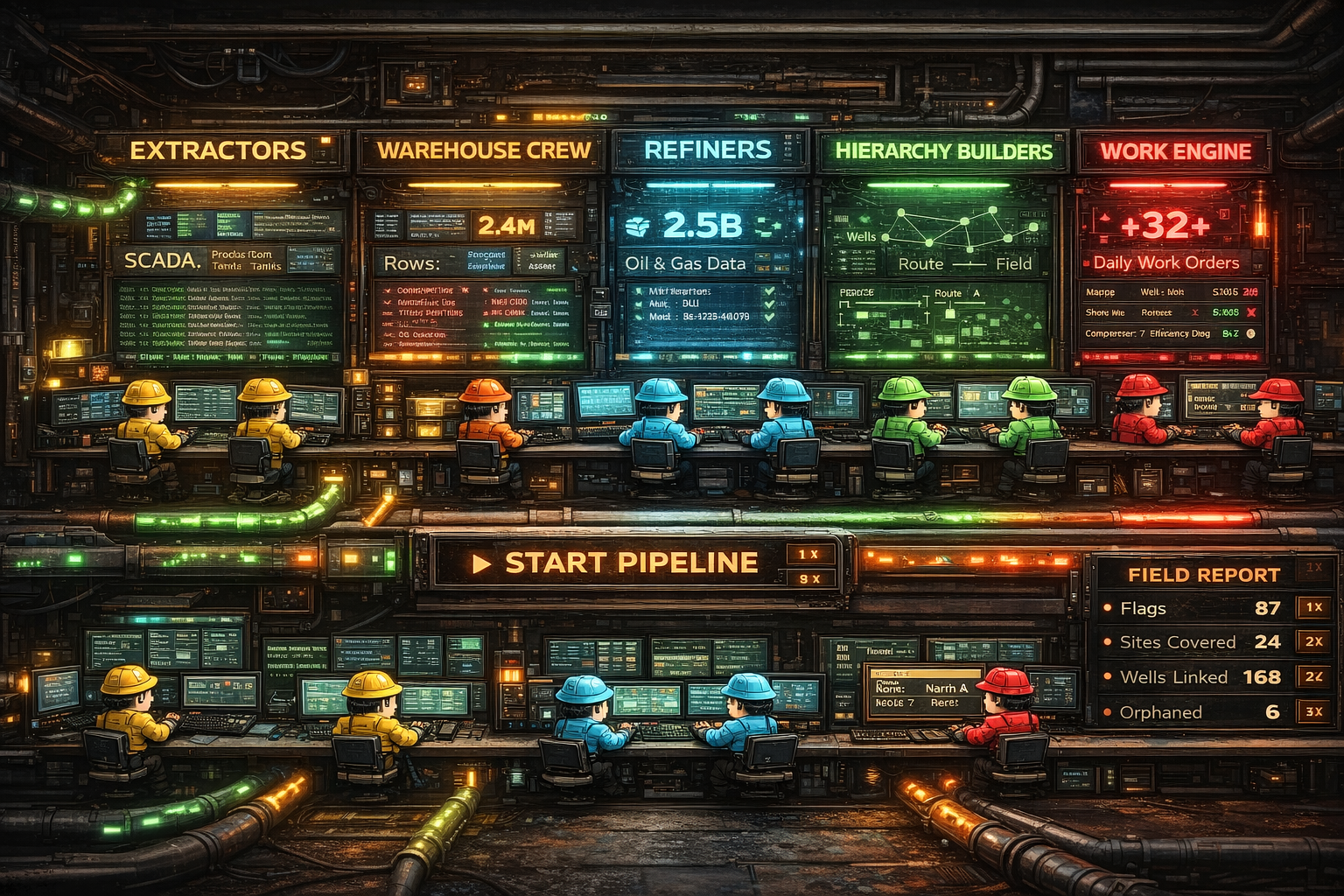
Five stations. Twelve agents. Running continuously from midnight to 6 AM. Each agent handles one step of the data-to-decision pipeline so your foreman opens a finished plan, not a wall of alarms.
Data Wellhead
Extraction Agents
Connect directly to your data lakehouse and pull every table your operation touches. Production. SCADA. Tanks. Work orders. Completions. 188 tables for one client. They do not miss.
Tank Farm
Warehouse Agents
Catch everything the Extractors throw and structure it into reliable storage. Every row tagged, every source tracked, every ingestion timestamped. Chain of custody for your data.
Processing Plant
Refinement Agents
Raw JSONB in, typed gold out. They know that one production accounting vendor uses OilWaterRunFlag=3 for oil (not 1). They know how to cross-reference wells across systems via API10. Your data quirks are their specialty.
Field Ops Map
Hierarchy Agents
The most underrated agents in the pipeline. They map every well, compressor, tank, and meter to its physical site, route, area, and field. No hierarchy means no context. These agents give your flags an address.
Operations Center
Decision & Execution Agents
The closers. Evaluate every asset against configurable rules, generate flags, rank them by priority, and package them into site-level work orders. By the time your foreman opens the dashboard, the day is already planned.
Powering the Agents
Six ML Systems Under the Hood
The agents orchestrate the pipeline. These ML systems provide the intelligence: detection, prediction, scoring, optimization, validation, and learning.
Built for Operations. Trusted by IT.
If you only satisfy one side, the deal dies. WorkSync wins because both the superintendent and the IT director see what they need.
For Operations Leaders
You do not need more dashboards. You need better decisions in the field.
- ✓Lease operators stop running routes based on habit
- ✓High-value wells get attention first, every day
- ✓Production loss is caught overnight, not in monthly reports
- ✓Fewer issues fall through the cracks
“We know exactly what to work today.”
For IT & Data Leaders
You have seen “AI for oil & gas” before. Most of it fails because the data layer is broken. WorkSync fixes that first.
- ✓Native integration with Fabric, Databricks, Snowflake, and AWS
- ✓Data reliability solved before AI: schema normalization, vendor logic, API mismatches
- ✓Full data lineage, traceability, and source-awareness on every record
- ✓Explainable, configurable decision logic with auditable outputs
“We finally have a system that turns our data platform into business value.”
The Differentiator
Every other solution
Shows you what happened
Dashboards, alerts, reports, and BI tools that tell you what already occurred. Your superintendent still has to figure out what to do about it.
WorkSync
Tells your crew what to do next, and why it matters
Agents clean your data. ML models score every issue. Routes are optimized. The plan arrives at 6 AM. Ranked, routed, and ready.
Frequently Asked Questions
Explore More
Dive deeper into how WorkSync transforms operations.
How WorkSync Works
See the full platform, from data ingestion to field execution.
Read more →GuideSample 6 AM Plan
See what a ranked, route-optimized daily work plan looks like.
Read more →Case StudyCase Studies
Real results from real deployments across 4,000+ wells.
Read more →GuideWhy WorkSync
What makes WorkSync different from dashboards, point solutions, and connected worker tools.
Read more →