
The Operations Prioritization System (OPS) Answers the Only Question That Matters: What Should We Be Working on Right Now?
Not another dashboard. Not another reporting tool. A continuous intelligence engine that finds what's costing you money, ranks it by economic impact, and routes the right work to the right people, every day.
The Gap Between Your Data and Your Field Crews Is Costing You Millions
Your SCADA system fires 200 alarms a day. Your pumpers drive fixed routes regardless of what's actually happening. Your superintendent juggles priorities from three different spreadsheets. Traditional threshold-based alarms do not learn which alerts matter. The result: duplicate site visits, wasted windshield time, alarm fatigue, and deferred production that quietly erodes your cash flow, often by 10-15% or more.
WorkSync's per-well ML models learn what normal looks like for each individual well, accounting for seasonal patterns, decline curves, and equipment age. The result is detection that adapts to your operation, not static thresholds that generate noise.
The data exists. The decisions don't follow from it. The Operations Prioritization System closes that gap.
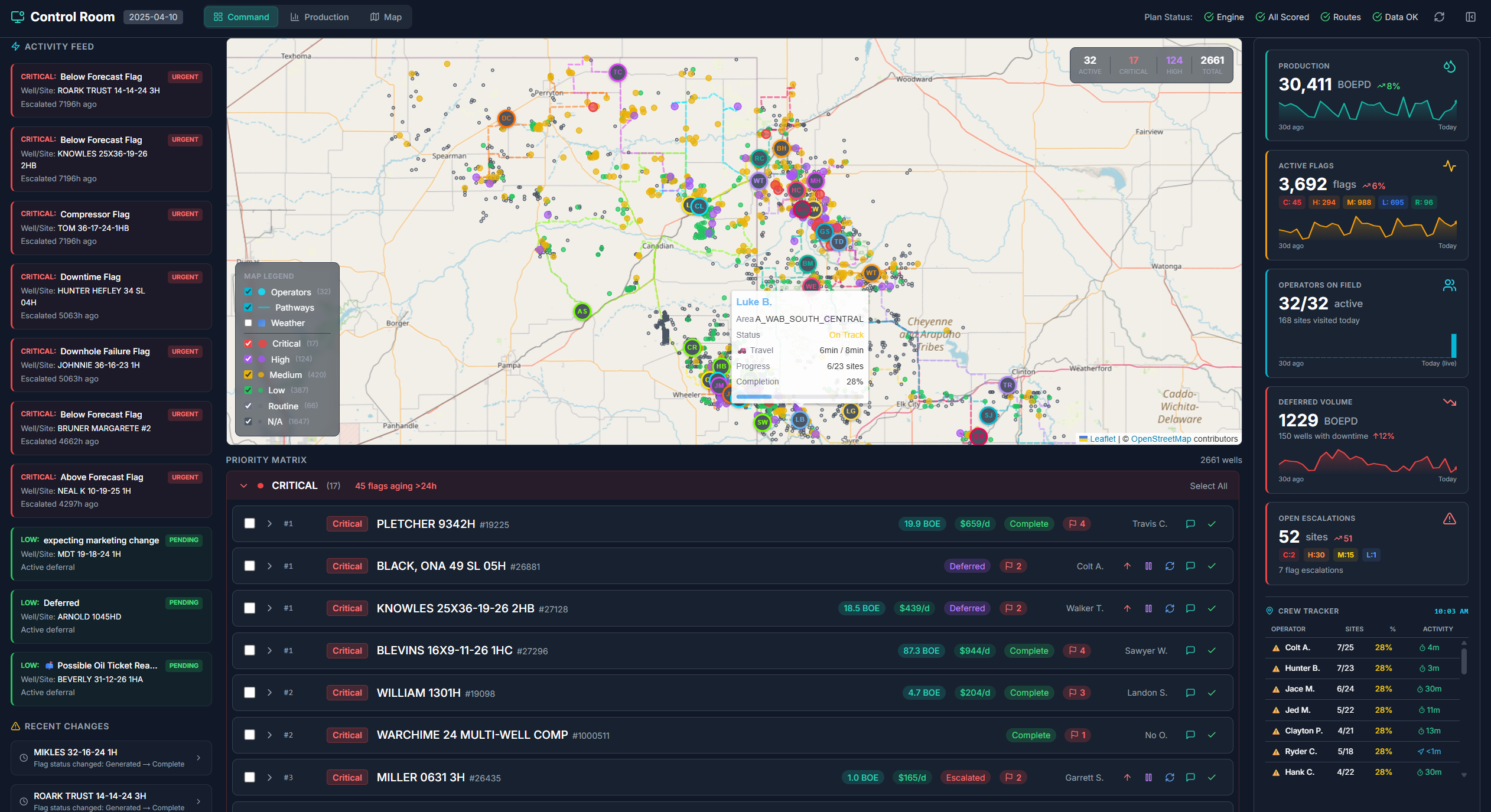
The OPS Control Room delivers real-time operational intelligence across your entire operation
Geospatial Route Map
Optimized crew routes based on ranked priorities and geography
Economic Scoring Panel
Every issue ranked by dollar impact; highest value surfaces first
Real-Time Activity Feed
Live visibility into crew locations, completions, and exceptions
The OPS Intelligence Loop — Powered by WorkSync AI
Connects to SCADA, production accounting, CMMS, ERP, and engineering systems. Extraction agents and an ML-driven data quality engine detect sensor drift, stuck values, and bad readings before they corrupt downstream decisions.
ML anomaly detection models learn each well's unique operational baseline across pressures, flow rates, temperatures, and runtime. Predictive failure models identify equipment degradation 48-72 hours before failure. Data QA agents automatically detect sensor drift, stuck values, and bad readings before they trigger false alarms.
Every issue receives an AI-calculated economic impact score: dollars at risk per hour of inaction. ML factors in production rate, commodity prices, working interest, trend trajectory, and intervention success probability.
Constraint-based optimization algorithms (the same class of AI used by UPS and Amazon for fleet routing) assemble scored tasks into crew-specific plans that maximize total economic recovery per crew-day.
Delivers AI-optimized work lists to field crews via mobile. When conditions change mid-day, the AI re-optimizes remaining plans across all crews. No call to dispatch required.
Every execution outcome feeds back into every model. The system learns your specific operation and gets measurably more precise over time.
Every completed task feeds back into the loop. The agent pipeline uses machine learning to improve with every execution cycle, validating predictions against actual outcomes and continuously refining priorities. Intelligence that augments your team's judgment, not replaces it.
OPS in Action
Every view is designed for a different decision. Here's what your team actually sees.
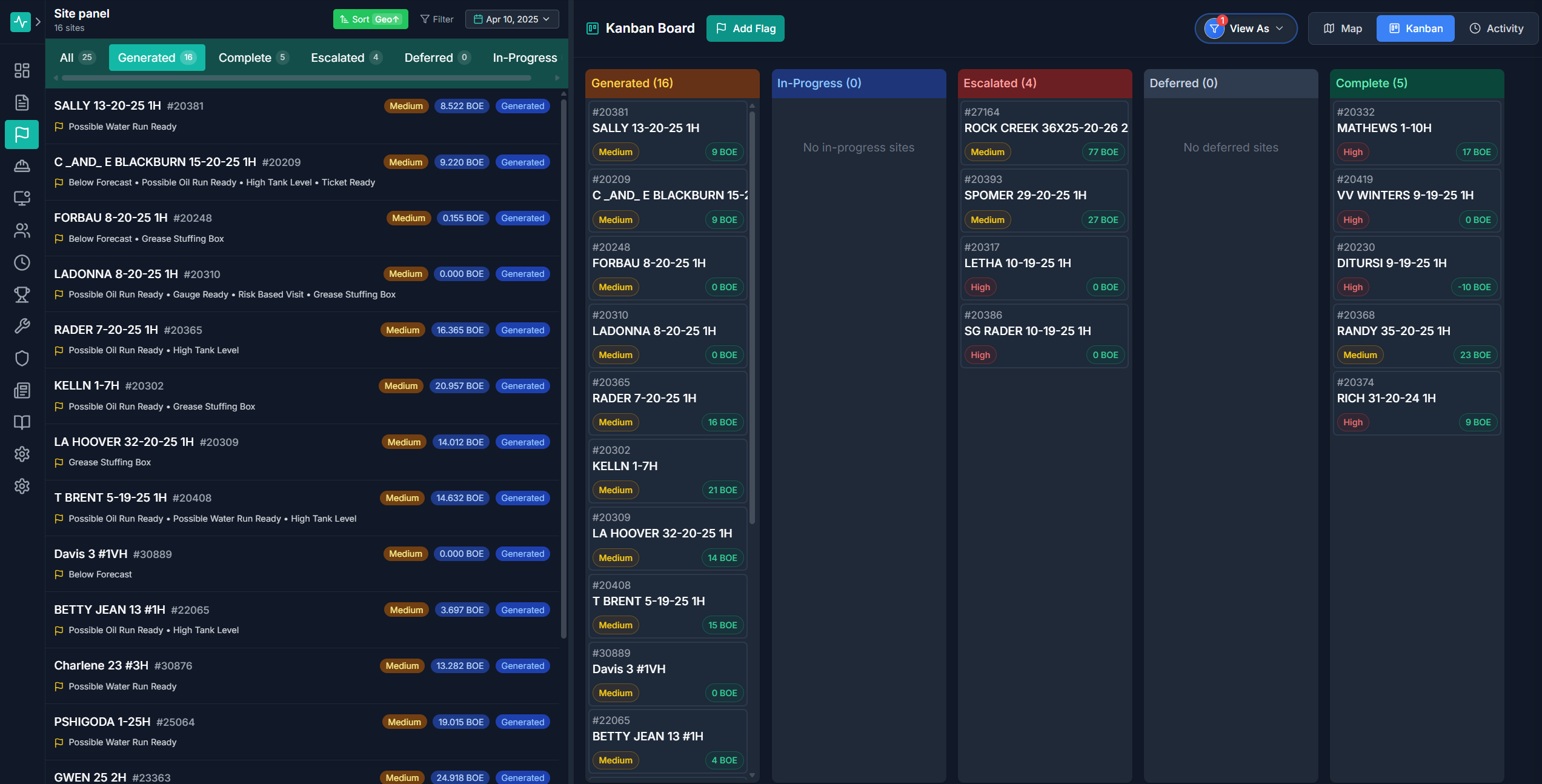
Ranked Work List
Every site scored and sorted by economic impact. Drag between columns as work progresses through the day.
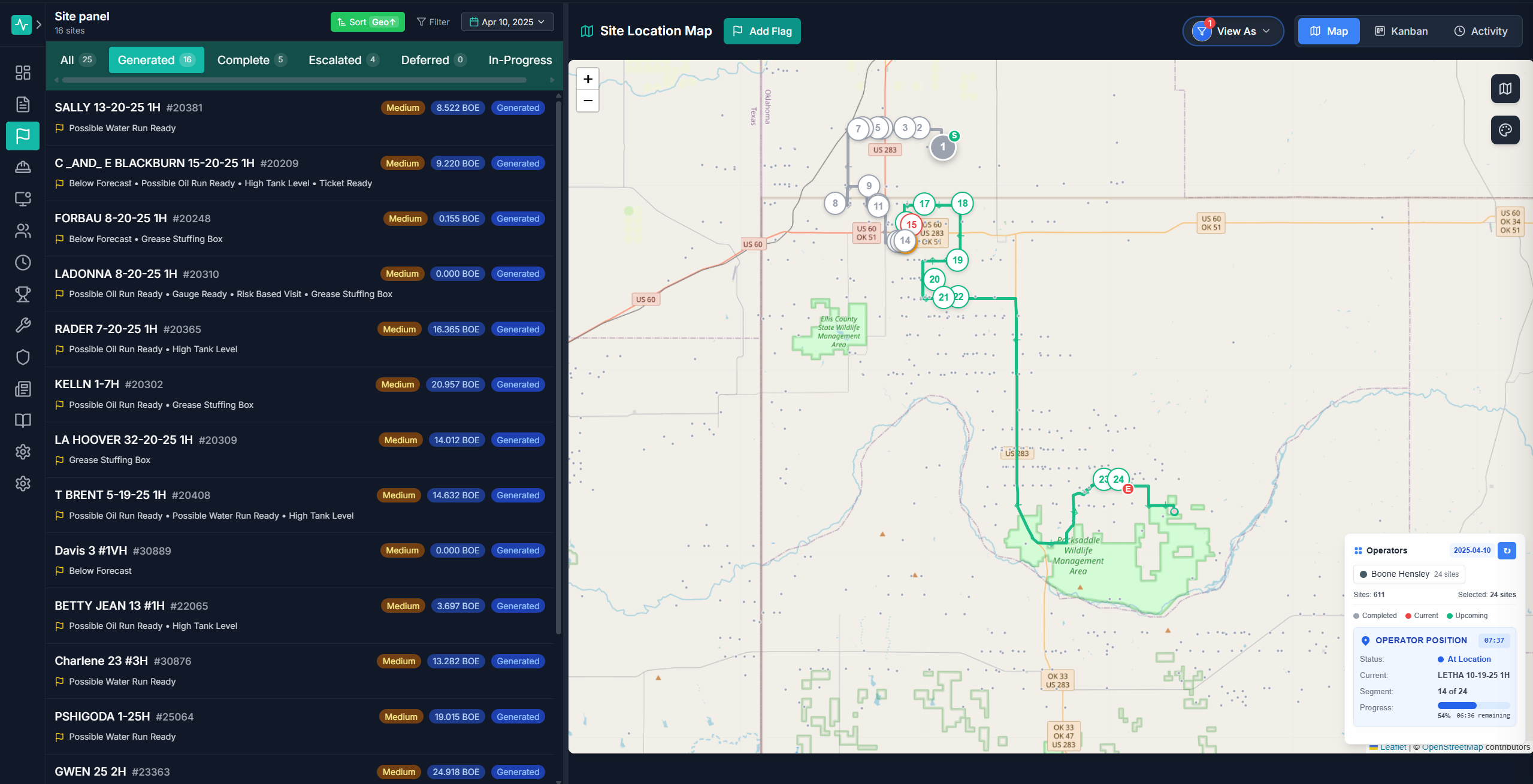
Optimized Route Map
Crew routes optimized by geography, priority, and constraints. Every stop ranked before the truck leaves the yard.
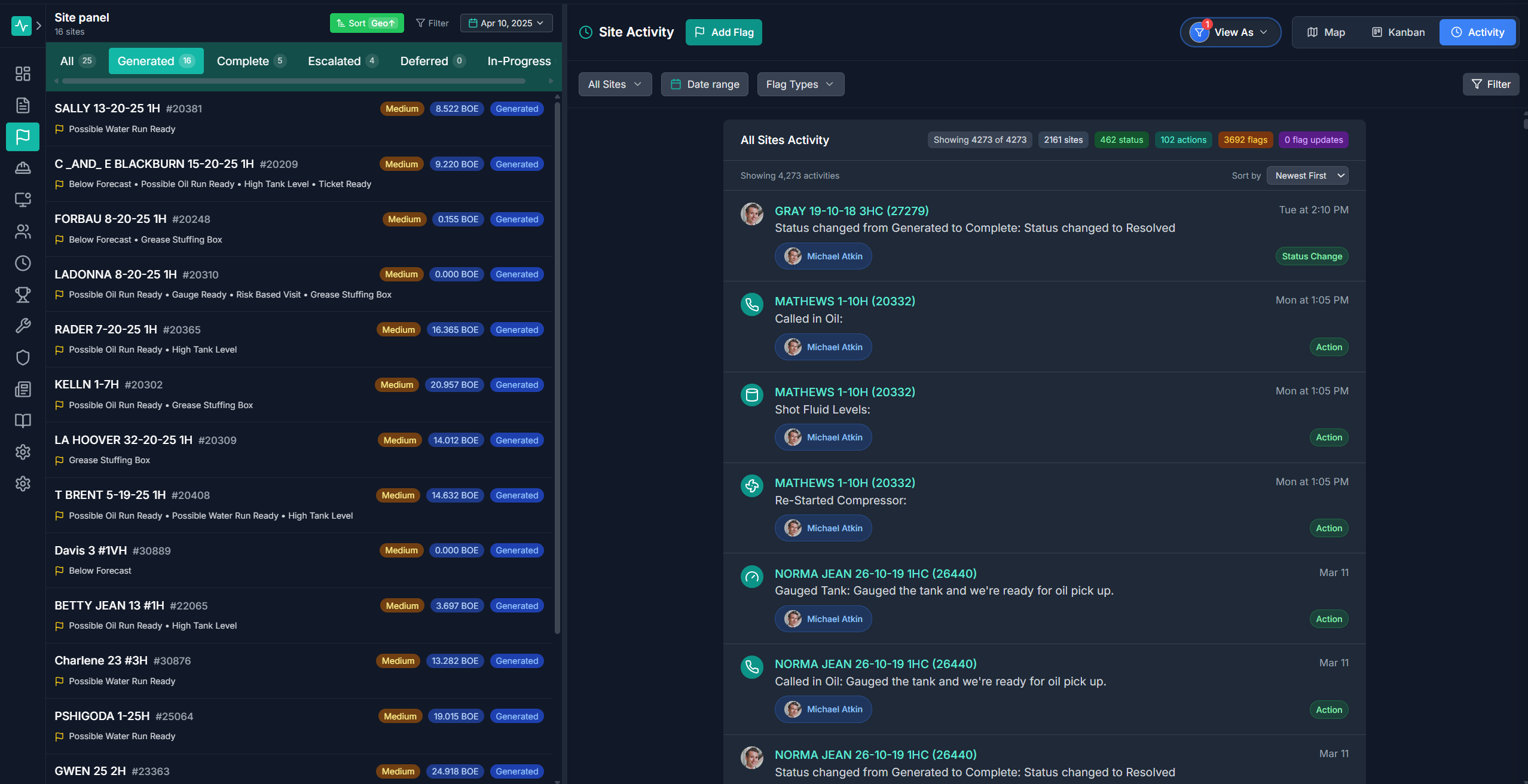
Real-Time Activity Feed
Live visibility into crew completions, status changes, and field notes. No phone calls needed.
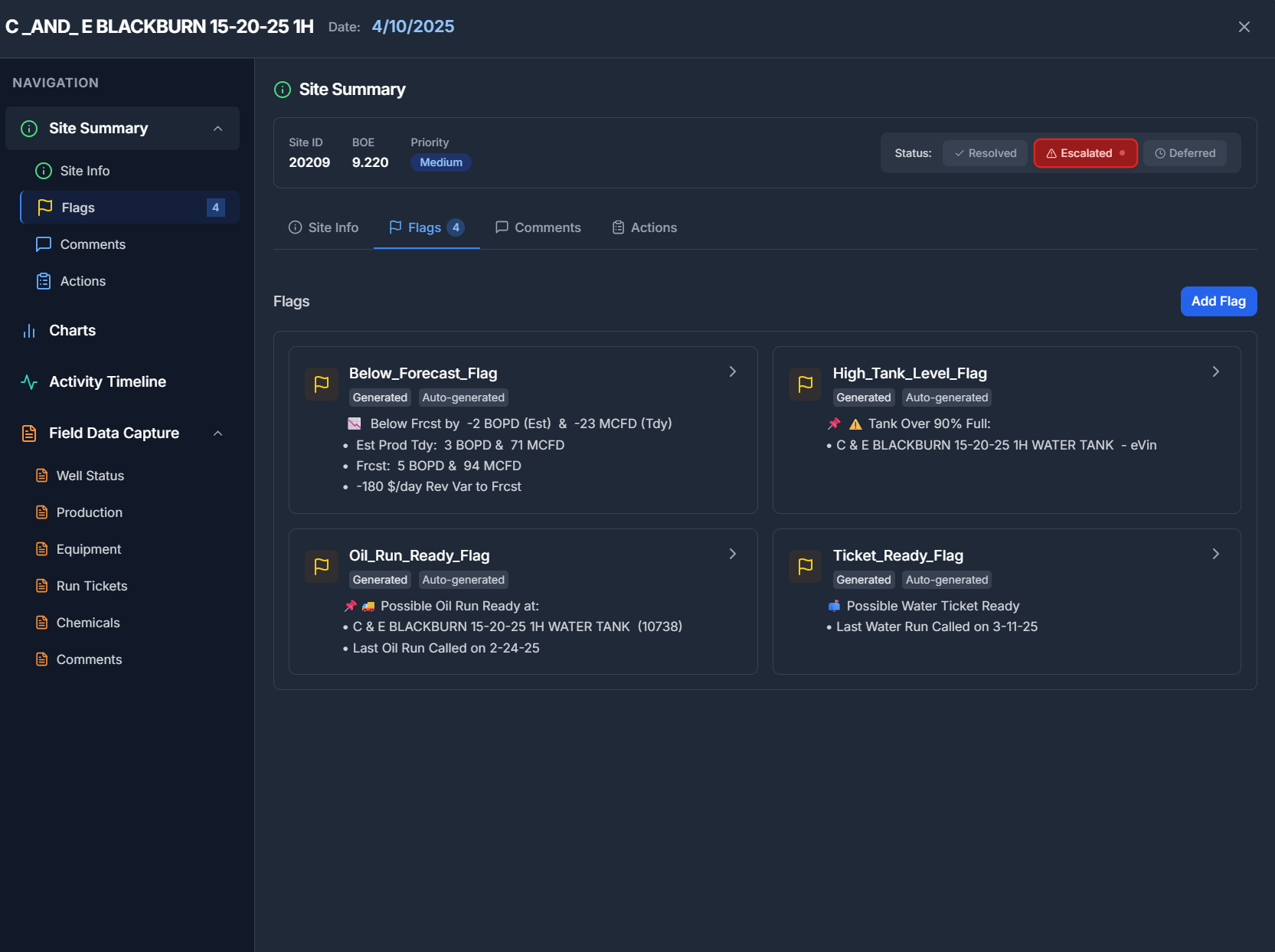
Automated Site Flags
Below-forecast production, high tank levels, oil run readiness, and ticket alerts, all auto-generated and scored.
WellOPS
For Upstream
Production optimization across hundreds of wells. State estimation, production allocation, haul prioritization, and chemical optimization, all scored by economic impact.
PipelineOPS
Coming SoonFor Midstream
PHMSA compliance creates $155.1M in first-year costs for operators. OQ-constrained dispatch, integrity risk scoring, and coordinated field execution across hundreds of miles.
Proven Outcomes
Production Uptime
5% less deferred production. 20-35% improvement in deferment capture.
Operating Expense
40% OPEX reduction. 15-25% LOE/BOE reduction. 15%+ free cash flow uplift.
Safety
TRIR reduced from 1.8 to 0.3. Risk-informed prioritization built into every decision.
Field Efficiency
35% fewer site visits. 40% lower liquid inventories. Optimized routing.
Executive Visibility
Real-time operational picture. No manual reports. No waiting for spreadsheet roll-ups.
SAFETY IMPACT: TRIR reduced from 1.8 to 0.3
An 83% reduction through risk-informed prioritization built into every daily plan.
From pump by exception to pump by priority to fully intelligent operations. All outcomes validated in live field operations across 4,000+ wells in the Western Anadarko Basin. Results measured vs. pre-deployment baseline.
Integrates With Your Existing Systems
Frequently Asked Questions
Ready to See What Your Operation Looks Like When Every Decision Has a Dollar Value?
Related Resources
Move beyond pump by exception to pump by priority, and beyond priority to fully AI-optimized field operations.